

Why LiFePO4 Batteries Are the Smarter Choice for Solar Lighting Systems
2026-08-14
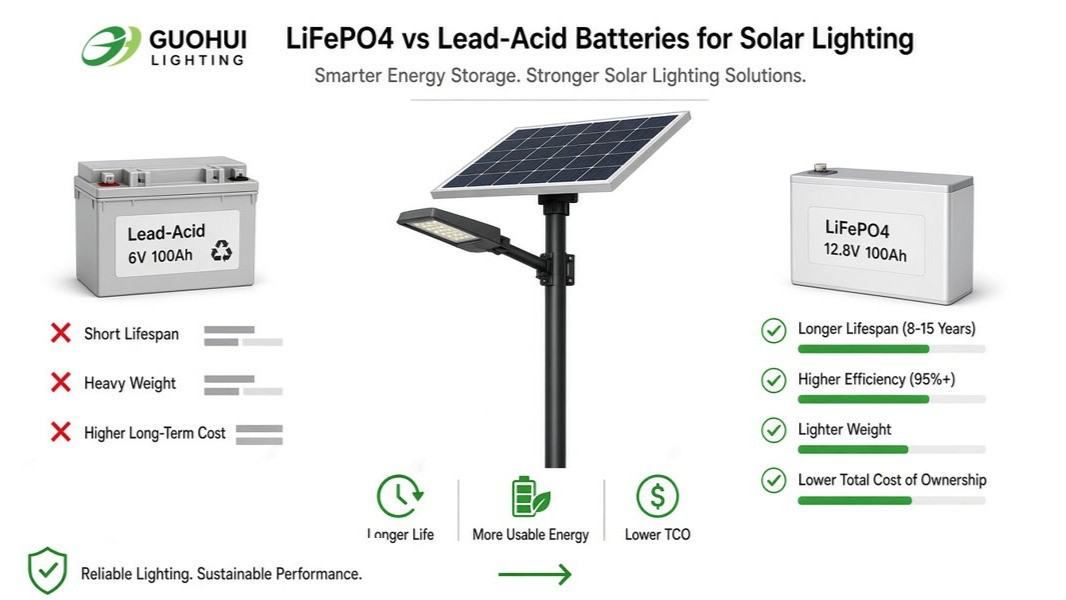
Solar lighting systems — from municipal street lights to commercial pathway and garden lighting — rely heavily on the battery that stores daytime solar energy for nighttime use. The battery chemistry you choose directly affects brightness consistency, maintenance frequency, replacement costs, and overall system reliability.
Two main options dominate the market: traditional lead-acid batteries (including AGM and gel types) and lithium iron phosphate (LiFePO4) batteries. While lead-acid has been widely used for years due to its lower upfront price, LiFePO4 has become the preferred choice for most modern solar lighting projects. Here’s why.
| Parameter | Lead-Acid (AGM/Gel) | LiFePO4 | Advantage |
|---|---|---|---|
| Usable Depth of Discharge | ~50% | 80–90%+ | LiFePO4 |
| Cycle Life | 300–800 cycles | 2,000–5,000+ cycles | LiFePO4 |
| Typical Service Life (daily use) | 2–5 years | 8–15 years | LiFePO4 |
| Round-Trip Efficiency | 75–85% | 95–99% | LiFePO4 |
| Weight (same usable capacity) | Much heavier | Approximately 1/3–1/4 the weight | LiFePO4 |
| Maintenance | Periodic checks & replacements | Virtually maintenance-free | LiFePO4 |
| Upfront Cost | Lower | Higher | Lead-Acid |
| 5–10 Year Total Cost of Ownership | Higher | Lower | LiFePO4 |
Solar lights cycle every night. A lead-acid battery limited to 50% depth of discharge requires oversizing the battery bank to deliver the same usable energy. It is also prone to sulfation when left partially charged during cloudy periods, which shortens its already limited lifespan.
LiFePO4 batteries deliver more usable energy from a smaller, lighter pack. Their high efficiency means more of the solar energy collected by the panel is actually stored and available at night. The flat voltage curve keeps light output stable for longer, and the long cycle life dramatically reduces the need for replacements — a major advantage for municipal and commercial projects where maintenance access is costly.
Lighter weight also simplifies installation, reduces structural requirements on poles, and lowers shipping costs.
Lead-acid batteries win on day-one cost. However, when you factor in shorter lifespan, more frequent replacements, labor, and energy losses, the total cost of ownership over 5–10 years usually favors LiFePO4. Many solar street light projects recover the higher initial investment of LiFePO4 within the first replacement cycle of a lead-acid system.
Lead-acid can still make sense for:
Very tight initial budgets or short-term pilot projects
Installations with easy access for frequent maintenance
Extremely cold environments where special charging protection for LiFePO4 is not yet in place
For most long-term, daily-cycling solar lighting applications, LiFePO4 delivers superior reliability and lower lifetime costs.
For reliable, low-maintenance, and cost-effective solar lighting, LiFePO4 batteries are the clearer long-term choice. They offer more usable energy, significantly longer service life, higher efficiency, and reduced total ownership costs compared with traditional lead-acid options.
At Guohui Lighting, we design our solar lighting solutions around high-performance LiFePO4 technology to ensure consistent nighttime performance and lasting value for our customers.
Product
Project
About
Contact us
7F,Bldg. A,Hytera Park,3 Baolong 4th Rd,Longgang,Shenzhen,China