

Navigating Solar Lighting Trade Amid Middle East Tensions
2026-05-26
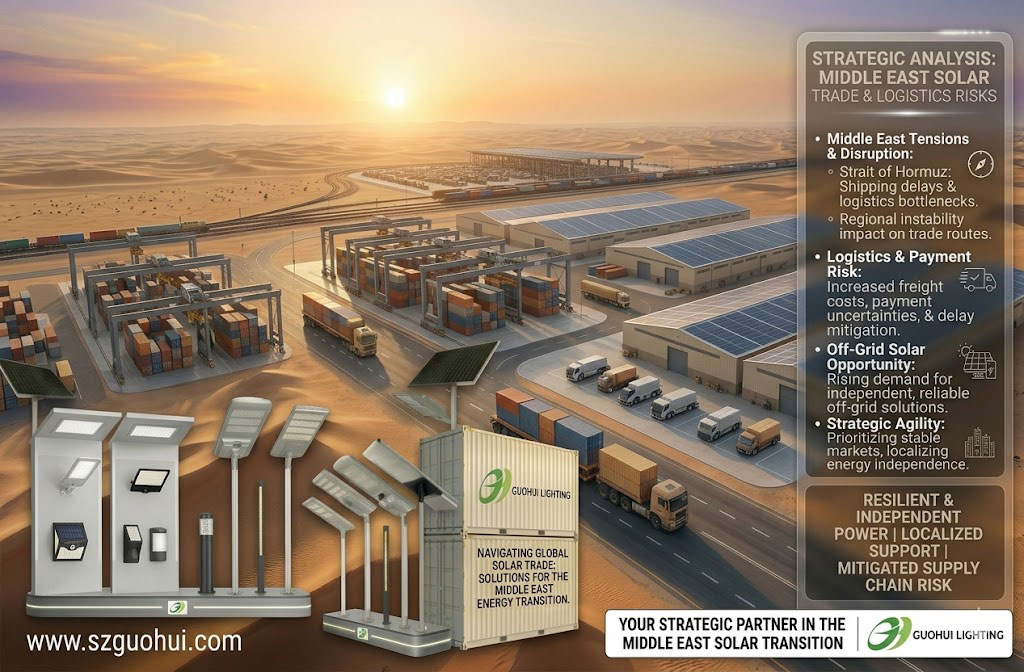
The ongoing Iran crisis and disruptions in the Strait of Hormuz are reshaping global trade lanes and supply chain logistics in the Middle East. For exporters of industrial-grade solar street lighting systems, sudden shipping delays, skyrocketing ocean freight costs, and complex payment uncertainties are posing real short-term operational hurdles.
Yet, as seasoned manufacturers, we know that geopolitical friction often serves as a massive catalyst for accelerating localized renewable energy infrastructure.
· Grid Resilience & Off-Grid Demand: Regions experiencing unstable or vulnerable grid power are rapidly prioritizing decentralized infrastructure. High-efficiency all-in-one solar street lights and rugged split-type solar lighting systems are becoming vital to ensuring uninterrupted public safety and highway illumination.
· Sustained Public & Private Investment: Wealthier Gulf nations are leveraging traditional energy revenue to fund massive national diversification plans. They are aggressively investing in smart city infrastructure, commercial logistics hubs, and large-scale industrial projects—maintaining a powerful, long-term demand for high-lumen LED solar modules, vertical solar wrapped poles, and robust solar high mast lights.
· Engineering for Extreme Environments: Mitigating long-term operational risks requires hardware that thrives under pressure. Modern B2B buyers are focusing heavily on technical engineering protocols—demanding military-grade LiFePO4 battery packs equipped with intelligent BMS (Battery Management Systems), high-efficiency monocrystalline photovoltaic panels, and superior IP68 waterproofing to handle intense desert heat and sandstorms.
For global manufacturers and project contractors, overcoming today’s supply chain volatility requires absolute strategic agility:
1. Emphasize Energy Independence: Frame your engineering proposals around self-sustaining, zero-maintenance off-grid resilience.
2. Target High-Intent Project Tenders: Focus marketing and manufacturing resources on stable, government-backed infrastructure and municipal highway lighting contracts.
3. Mitigate Supply Chain Risk: De-risk logistics by utilizing strategic regional warehouses to ensure steady component availability and buffer stocks against maritime bottlenecks.
The global energy transition isn't pausing for logistics bottlenecks—it is adapting to circumvent them.
Explore our full range of industrial engineering solutions and technical specifications: www.szguohui.com
Product
Project
About
Contact us
7F,Bldg. A,Hytera Park,3 Baolong 4th Rd,Longgang,Shenzhen,China